Innovation Management: Why Internal Innovation Culture is Your Competitive Advantage
The statistics are sobering. Research shows that 67% of well-formulated strategies fail due to poor execution, and 90% of organizations struggle to execute their strategies successfully. The missing link? Employee engagement in the innovation process.
This article explores why nurturing innovation culture from within your organization delivers superior results compared to relying solely on external resources, and provides actionable strategies to transform your workforce into a powerhouse of creative problem-solving.
The Case for Internal Innovation: Why Your Employees Are Your Best Innovators
Deep Contextual Knowledge
Your employees possess something external consultants can never replicate: intimate, lived experience with your organization's challenges and opportunities. They understand the nuances of your operations, the pain points of your customers, and the constraints of your resources in ways that take outsiders months—or years—to grasp.
Consider this: when a frontline customer service representative identifies a recurring complaint pattern, they're not just spotting a problem—they're seeing an innovation opportunity grounded in real customer needs. When a manufacturing floor worker notices an inefficiency in the production line, they're offering insights that no external audit could uncover without extensive observation.
This contextual knowledge creates implementation-ready innovations. Ideas generated internally come with built-in understanding of feasibility, cultural fit, and resource requirements. They're not theoretical solutions that look good on paper but fail in practice.
Cost Efficiency and Resource Optimization
The financial case for internal innovation is compelling. While external innovation sources—consultants, acquisitions, licensing—require significant upfront investment, internal innovation leverages existing resources and talent. Organizations that successfully engage employees in innovation report 3-5x higher ROI on innovation investments compared to those relying primarily on external sources.
Moreover, internal innovation builds organizational capability that compounds over time. Each successful employee-driven initiative strengthens the innovation muscle, creating a self-reinforcing cycle of continuous improvement. External innovation, by contrast, often creates dependency relationships that drain resources without building internal capacity.
Cultural Alignment and Faster Implementation
External innovations, no matter how brilliant, face the challenge of cultural integration. New processes, technologies, or strategies imported from outside must overcome organizational antibodies—resistance to change, misalignment with existing workflows, and skepticism from those who weren't involved in their development.
Internal innovations, however, come pre-aligned with organizational culture. They're designed by people who understand "how things work around here" and can navigate the informal networks that determine whether initiatives succeed or fail. This cultural fit translates to 40-60% faster implementation times and significantly higher adoption rates.
Sustainable Competitive Advantage
Perhaps most importantly, internal innovation culture creates a sustainable competitive advantage that's difficult for competitors to replicate. While external innovations can be copied or purchased, an organization's innovation culture—the collective capability, mindset, and processes that enable continuous creativity—is unique and defensible.
Companies like 3M, Google, and Toyota have demonstrated that sustained innovation leadership comes not from occasional breakthrough acquisitions but from systematically harnessing the creative potential of their entire workforce.
The Innovation Culture Framework
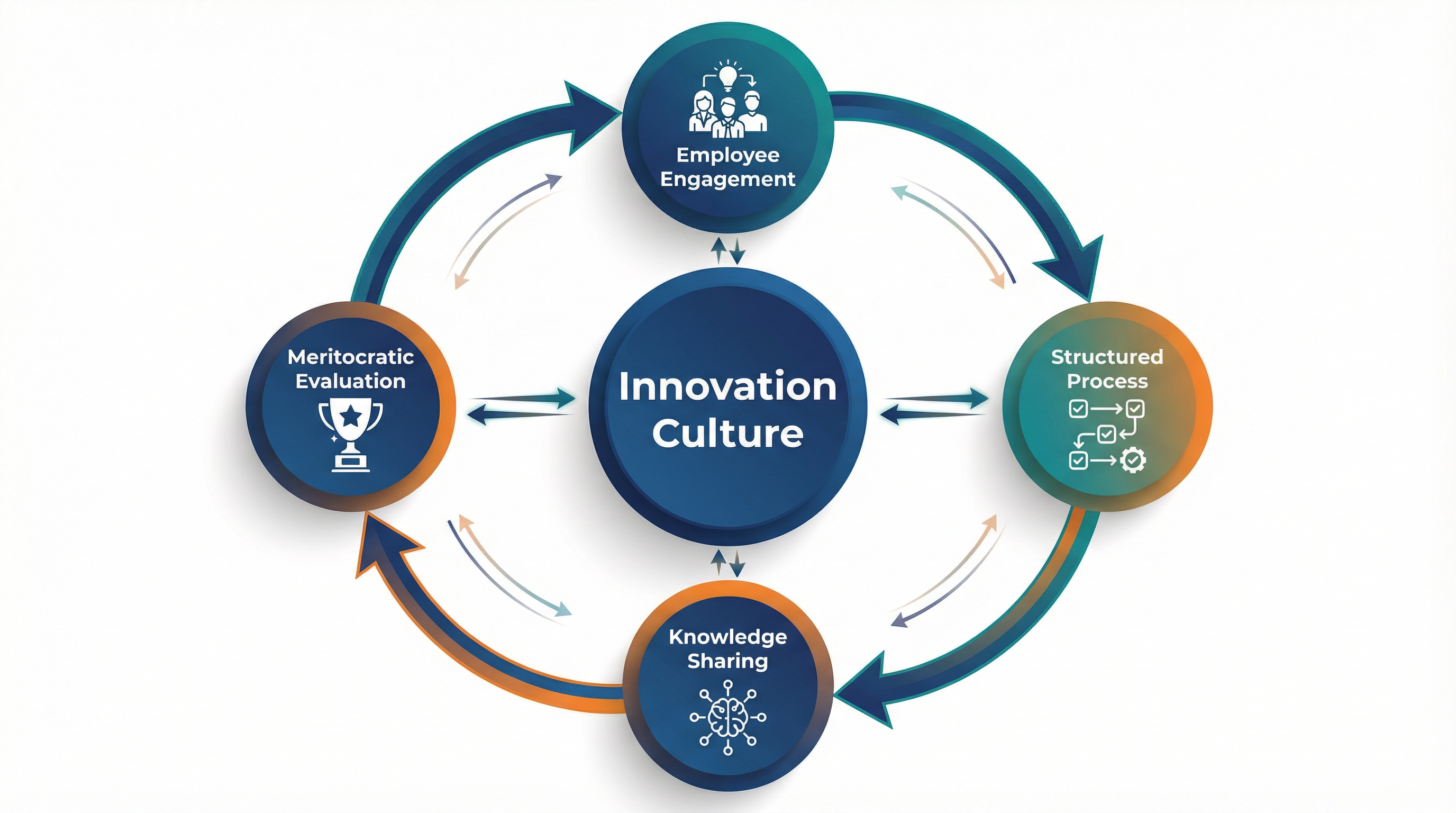
Building a thriving internal innovation culture requires four interconnected pillars:
1. Employee Engagement
Employee engagement forms the foundation of innovation culture. Research by Rao (2016) demonstrates that engaged employees are 3x more likely to contribute innovative ideas and 4x more likely to see those ideas through to implementation.
However, engagement in innovation requires more than enthusiasm—it demands structured opportunities, clear expectations, and visible impact. Organizations must answer three critical questions for employees:
- Why should I innovate? (Purpose and incentives)
- How can I innovate? (Process and tools)
- What happens to my ideas? (Transparency and follow-through)
2. Structured Process
The failure of traditional suggestion boxes offers a cautionary tale. Open-ended idea collection without structure leads to three problems:
- Misalignment: Ideas don't connect to strategic priorities
- Overwhelm: Too many low-quality submissions to evaluate effectively
- Disengagement: Employees feel their contributions disappear into a black hole
Successful innovation programs replace open suggestion boxes with targeted innovation challenges. Instead of asking "What's your idea?", effective organizations ask specific questions like:
- "How can we reduce customer onboarding time by 30% using existing resources?"
- "What process improvements would eliminate the most common bottlenecks in your daily work?"
- "How might we better leverage data we're already collecting to serve customers?"
3. Knowledge Sharing and Collaboration
Innovation rarely happens in isolation. The most impactful innovations emerge when diverse perspectives collide—when the insights of frontline employees meet the strategic vision of leadership, when technical expertise combines with customer empathy, when cross-functional teams tackle challenges together.
2.5x Higher Success Rate
Organizations fostering cross-functional collaboration achieve 2.5x higher innovation success rates than those with siloed knowledge structures.
— Lin & McDonough (2011)
4. Meritocratic Evaluation
Nothing kills innovation engagement faster than the perception that ideas succeed based on politics rather than merit. Employees need confidence that the best ideas—not the loudest voices or highest titles—will be implemented.
When employees trust the evaluation process, participation rates increase dramatically. Hansen et al. (2017) found that organizations with transparent, merit-based innovation processes see 60% higher sustained participation compared to those with opaque decision-making.
The Employee-Driven Innovation Process
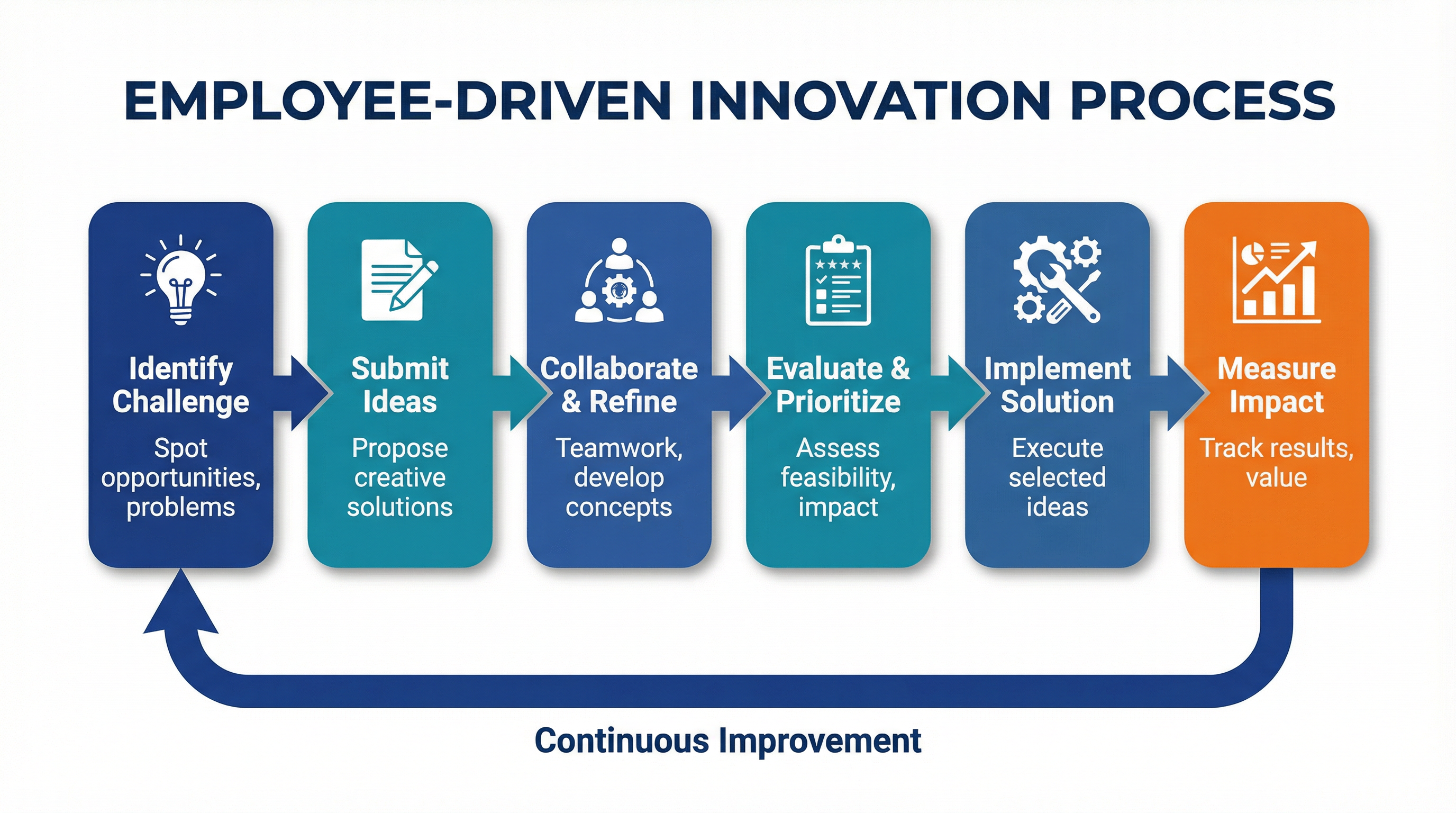
Successful employee innovation follows a structured six-stage process that transforms ideas into measurable business impact.
Internal vs External Innovation: A Balanced Perspective
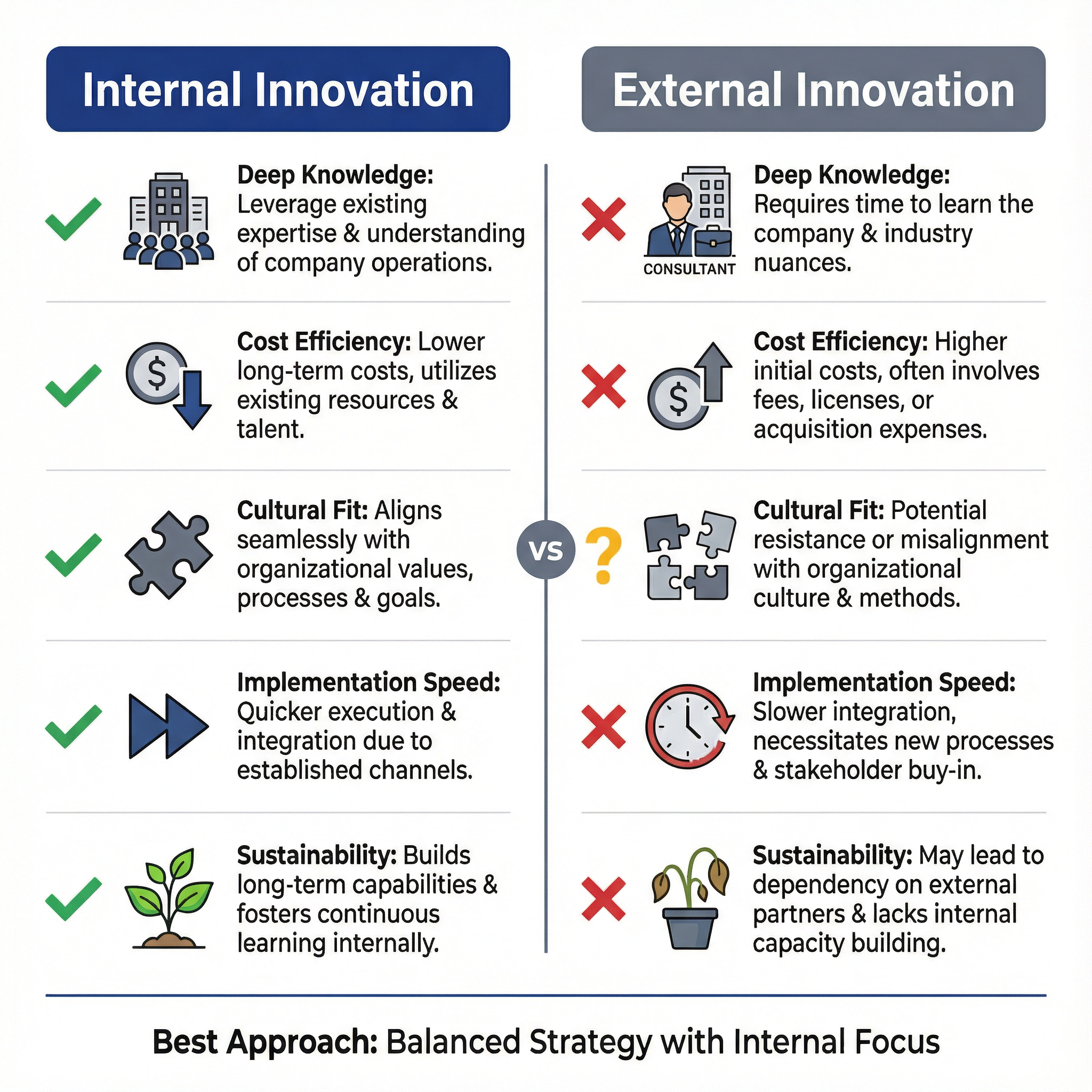
While this article advocates strongly for internal innovation, the optimal approach isn't either/or—it's strategic balance with internal focus. The most successful organizations follow a 70-30 rule: 70% of innovation efforts focused internally, 30% leveraging external sources.
Common Barriers to Employee Innovation—and How to Overcome Them
Barrier 1: "We're Too Busy"
The Problem: 40-60% of employees cite lack of time as the primary barrier to innovation participation.
The Solution: Make innovation part of daily work, not an add-on. Effective strategies include dedicated innovation time, process improvement focus, micro-innovations, and recognition of innovation as valuable work.
Barrier 2: Lack of Visibility and Impact
The Problem: Employees don't see what happens to their ideas, leading to cynicism and disengagement.
The Solution: Create transparency throughout the innovation process with regular communication, public recognition, clear explanations of decisions, and quantified impact reporting.
Barrier 3: Fear of Failure
The Problem: Risk-averse cultures punish failed experiments, discouraging creative risk-taking.
The Solution: Reframe failure as learning by celebrating "intelligent failures," sharing lessons openly, and protecting innovators from career consequences of well-designed experiments.
Barrier 4: Siloed Knowledge
The Problem: Departmental boundaries prevent the cross-pollination of ideas that drives breakthrough innovation.
The Solution: Design for collaboration through cross-functional teams, job rotation programs, internal innovation conferences, and digital collaboration platforms.
How Innova Catalyst Enables Internal Innovation Culture
Innova Catalyst, part of the Plan360 suite, addresses every element of successful employee-driven innovation:
Key Capabilities
Structured Innovation Challenges
Pose targeted innovation challenges aligned with strategic priorities, ensuring ideas are relevant and actionable from the start.
Seamless Participation
Mobile-first design and integration with existing tools make innovation participation frictionless.
Collaborative Refinement
Built-in collaboration features enable cross-functional teams to develop and strengthen ideas together.
Transparent Meritocracy
Data-driven evaluation framework applies consistent criteria to all submissions, building trust in the process.
Impact Measurement
Comprehensive analytics track innovation from submission through implementation, quantifying ROI and engagement.
AI-Powered Insights
Leverage AI to identify patterns, suggest connections between ideas, predict implementation success, and recommend resources.
Real-World Impact: The ROI of Internal Innovation
Organizations that successfully engage employees in innovation report transformative results:
On innovation investments vs external-focused approaches
Faster implementation of new initiatives
Increase in quality idea submissions after training
Higher success rates with cross-functional collaboration
Conclusion: Building Your Innovation Advantage
The evidence is clear: organizations that nurture innovation culture from within outperform those relying primarily on external sources. Your employees possess deep contextual knowledge, cultural alignment, and implementation capability that no external partner can match.
However, harnessing this potential requires more than enthusiasm—it demands structured processes, collaborative platforms, meritocratic evaluation, and sustained leadership commitment.
The question isn't whether your organization should invest in internal innovation culture. The question is: can you afford not to, when the average company lifespan continues to shrink and competitive disruption accelerates?
The tools, strategies, and frameworks exist to transform your workforce into a sustainable innovation engine. The only question remaining is: when will you start?
References
- Rao, V. (2016). Innovation through employee engagement. Asia Pacific Journal of Advanced Business and Social Studies, 2(2), 1-9.
- Aman, M.K. (2019). The effect of employee engagement and organization culture on company innovation capability. International Journal of Business and Management, 14(5), 68-78.
- Lin, H.E., & McDonough, E.F. (2011). Investigating the role of leadership and organizational culture in fostering innovation ambidexterity. IEEE Transactions on Engineering Management, 58(3), 497-509.
- Hansen, K., Amundsen, O., & Aasen, T.M.B. (2017). Management practices for promoting employee-driven innovation. In Workplace Innovation (pp. 277-295). Springer.
- Flocco, N., & Canterino, F. (2022). To control or not to control: How to organize employee‐driven innovation. Creativity and Innovation Management, 31(3), 445-461.
- Chandel, A., Pandey, A., & Yadav, M. (2025). Innovation culture and employee engagement. In Digital Transformation and Job Creation (pp. 156-173). IGI Global.
- Dellova, R.I., & Tian, Y. (2024). Fostering innovation: Exploring key factors. Organization and Human Capital Development, 3(1), 45-62.
- Nelson, C. (2025). How to engage employees in innovation. HYPE Innovation Blog.
- Harvard Business Review. (2023). Why strategy execution unravels. Harvard Business Review, 101(2), 64-73.
- ClearPoint Strategy. (2024). The state of strategy execution: 2024 benchmark report.
- Innosight. (2021). Corporate longevity: Turbulence ahead for large organizations.
- ISO 56001:2019. Innovation management system — Requirements. International Organization for Standardization.
Ready to Transform Your Innovation Culture?
Discover how Innova Catalyst can help you harness the creative potential of your entire workforce and drive measurable business impact.
Learn More About Innova Catalyst